
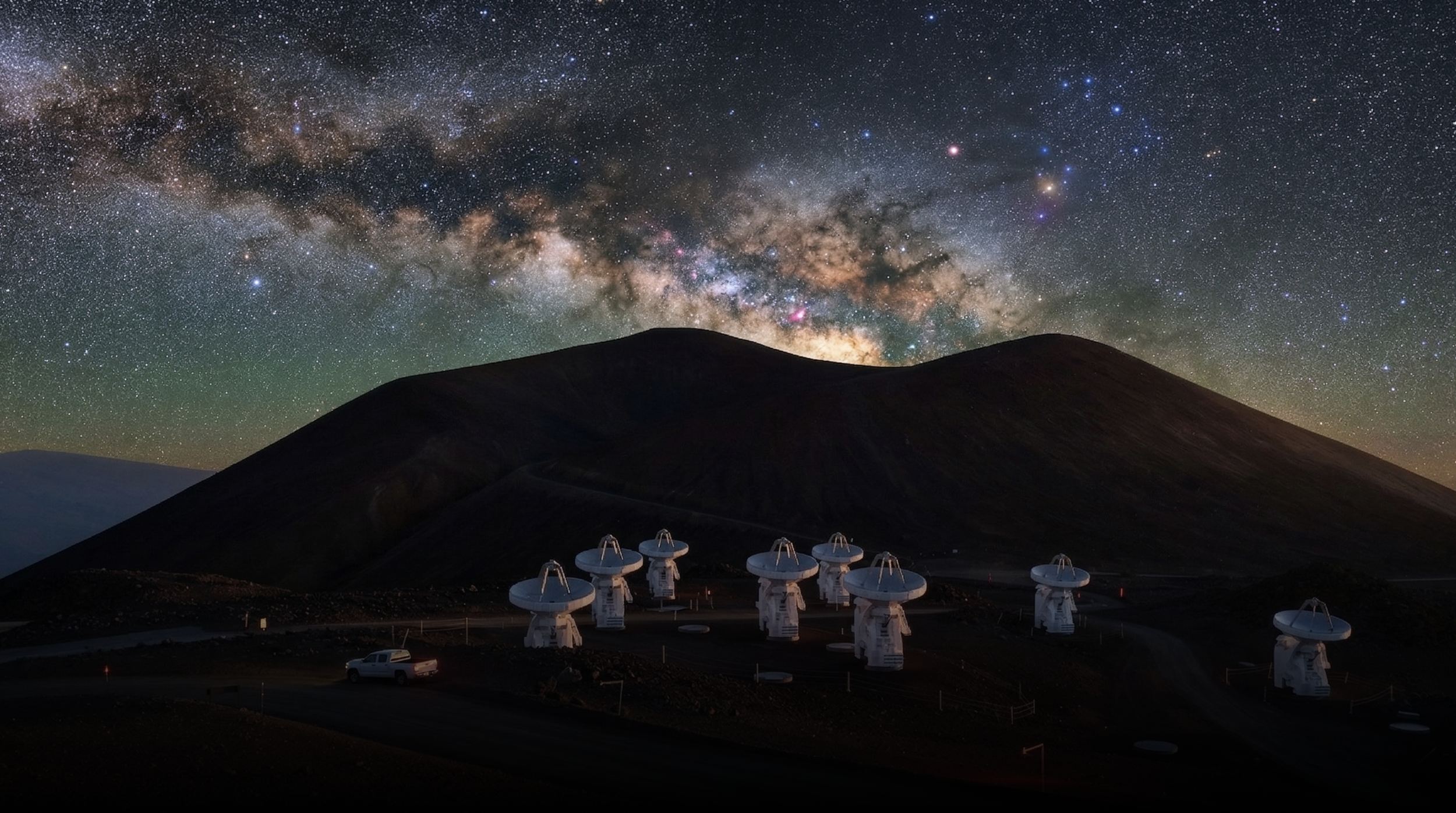

A World-Class Observatory on the Roof of the World
The facility consists of eight 6-meter radio dishes working together as one telescope, positioned near the summit of Maunakea on Hawai'i's Big Island at approximately 4,080 m elevation. The SMA enables observation of planets, comets, star birth, and supermassive black holes.
The SMA is a type of observatory known as an interferometer — eight radio dishes, each 6 meters in diameter, observing the same astronomical object simultaneously. Combining the light measured by all the dishes produces an interference pattern resulting in a sharper image than any individual antenna could achieve. The eight-antenna interferometer behaves like a single telescope as much as 500 meters across.
The observatory observes at wavelengths of about a millimeter, lying at the boundary between infrared and radio wavelengths. This light is emitted by the interstellar clouds that provide the raw materials for star formation — and it pierces through dust that hides many objects from view at visible wavelengths. Many molecules have unique spectral fingerprints at submillimeter wavelengths, allowing the SMA to identify them and measure their motions using the Doppler effect.
SAO
The Smithsonian Astrophysical Observatory co-operates the SMA from Cambridge, Massachusetts, as part of the Center for Astrophysics | Harvard & Smithsonian.
ASIAA
The Academia Sinica Institute of Astronomy and Astrophysics, based in Taipei, Taiwan, is the SMA's international partner, contributing to instrumentation and observing programs.
EHT
The SMA is a key element of the Event Horizon Telescope — the global VLBI network that produced the first image of a supermassive black hole.
Observing from Maunakea
Water vapor in Earth's atmosphere absorbs much of the submillimeter light from astronomical sources before it can reach the ground. This is why the observatory was built near the summit of Maunakea — a dormant volcano rising 4,080 meters above sea level, usually above more than 90% of the atmosphere's water vapor. The site offers exceptional atmospheric transparency, making it one of the finest locations on Earth for submillimeter astronomy.
As Hawai'i's highest mountain, Maunakea holds deep cultural significance for Native Hawaiian communities. The SMA is fortunate to conduct its science at this exceptional site and recognizes the responsibility that comes with operating on Maunakea. The observatory is committed to being a respectful steward of the mountain and to fostering positive relationships with the local community.
Maunakea is one of the most sacred places in Hawaiian culture and one of the best astronomical observing sites on the planet. The ngSMA is privileged to pursue its science from this extraordinary summit, and we are committed to honoring the mountain and the community it belongs to.
A Global Collaboration
The ngSMA is a joint project of two leading astrophysics institutions, supported by the Smithsonian Institution and Academia Sinica.
Smithsonian Astrophysical Observatory
Part of the Center for Astrophysics | Harvard & Smithsonian, SAO is one of the world's leading astrophysics research institutions and co-operates the SMA from its headquarters in Cambridge, Massachusetts. SAO provides scientific leadership, engineering support, and manages the observatory's operations alongside ASIAA.
Academia Sinica Institute of Astronomy and Astrophysics
Based in Taipei, Taiwan, ASIAA is the SMA's international partner, jointly operating the telescope and contributing to its scientific program, instrumentation development, and observing capabilities. ASIAA brings world-class expertise in receiver technology and submillimeter science.
Center for Astrophysics | Harvard & Smithsonian
The CfA is a collaboration between Harvard University and the Smithsonian Institution. It houses more than 700 scientists and is one of the largest and most diverse astrophysical institutions in the world. The SMA is one of the CfA's major research facilities and a cornerstone of its radio and submillimeter astronomy program.
Get in Touch
The SMA operates from two locations — our science headquarters in Cambridge, Massachusetts, and our telescope operations base in Hilo, Hawai'i.
General Inquiries
For questions about the SMA, observing proposals, or general information: